admin@shawa.in
  +91-9870100205
 +91-9654048068


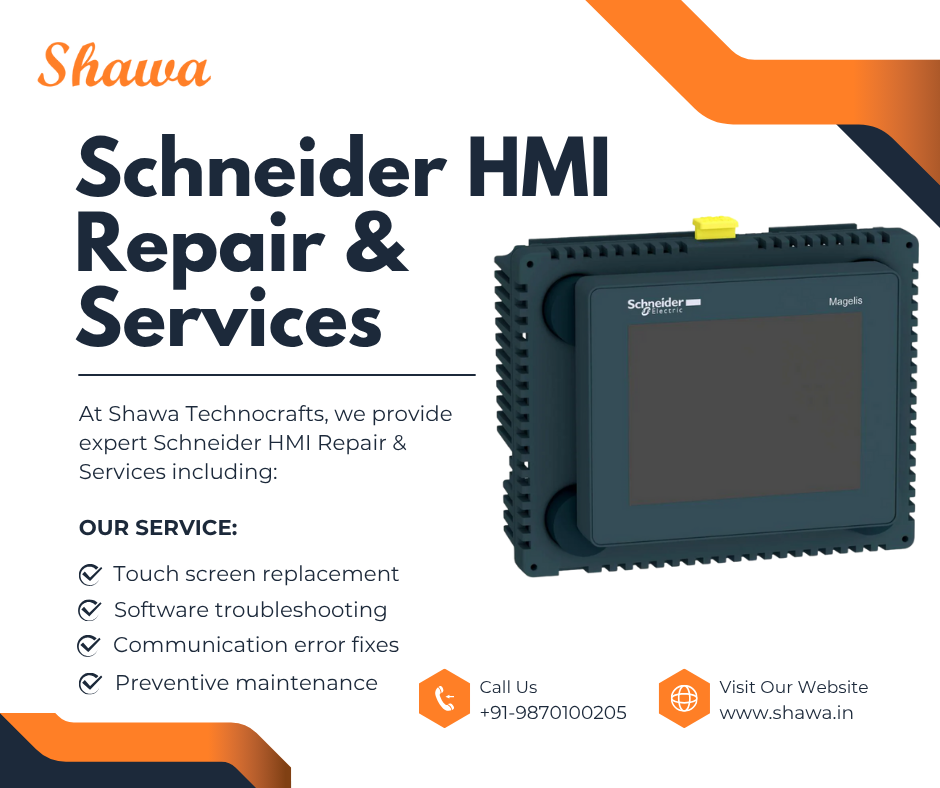
Schneider HMI Repair Services in Ghaziabad | Shawa Technocrafts Pvt. Ltd.
Schneider HMI Repair & Services – Complete Troubleshooting and Maintenance Guide
In today’s fast-paced industrial environment, Human Machine Interfaces (HMIs) play a crucial role in monitoring and controlling automated systems. Among the leading HMI manufacturers, Schneider Electric stands out for its advanced features, high performance, and long-lasting reliability. However, like any electronic equipment, Schneider HMIs can experience failures due to environmental stress, electrical faults, or wear and tear over time. This is where professional Schneider HMI repair and services become essential to ensure smooth operations and avoid costly downtime.
Understanding Schneider HMI and Its Importance
A Schneider HMI (Human Machine Interface) connects the operator with the machine. It displays real-time data, alarms, system performance, and allows direct control over industrial processes. When the HMI malfunctions, the entire production line can come to a halt. Therefore, timely diagnosis and repair are crucial to restore optimal performance and prevent production losses.
Common Issues in Schneider HMI Systems
Schneider HMIs are built to operate in harsh industrial conditions, yet certain factors can lead to errors or damage. Some common problems include:
-
Touch screen failure or unresponsive display
-
Software corruption and boot errors
-
Power supply problems
-
Communication port failure
-
Overheating and internal component damage
-
Display flickering or backlight issues
These faults, if ignored, may escalate into complete system failure. Early identification and professional repair can help avoid equipment replacement and reduce downtime costs.
Benefits of Professional Repair Services
Opting for expert Schneider HMI repair services offers several advantages over replacement:
✔ Cost-Effective Solution
Repairing an existing HMI is more economical than purchasing a new one. Advanced diagnostic tools identify the exact cause of failure, allowing targeted repairs.
✔ Quick Turnaround Time
Certified technicians provide fast service with minimal downtime, ensuring that operations resume without extended disruption.
✔ Original Components & Long-Term Reliability
Using high-quality spare parts ensures the durability and performance of the HMI. Technicians also upgrade firmware and optimize system performance during servicing.
✔ Preventive Maintenance
Regular maintenance helps avoid recurring failures. Professional services include cleaning internal circuits, checking voltages, reloading software, and ensuring the HMI operates at optimal performance.
Types of Schneider HMI Repair & Services Offered
A comprehensive repair service typically includes:
-
Touch screen replacement
-
Communication error fixes
-
Firmware reinstallation and programming support
-
I/O module repair
-
Display and backlight repair
-
Power supply troubleshooting
-
Preventive maintenance and testing
These services ensure that the HMI functions like new and meets industrial operational standards.
Why Timely HMI Repair Is Essential
Downtime in automation systems can lead to production loss, missed deadlines, and financial setbacks. Timely repair not only restores system efficiency but also prevents future failures. Professional technicians use advanced diagnostic tools to detect underlying issues and provide tailored solutions that improve productivity and system longevity.